A business virtual number app gives you a professional phone number that runs over the internet — so your team can call and text customers from any device, keep personal numbers private, and skip the cost of traditional phone lines. In this article we compare five of the best virtual number apps for business calls and texts, explain what to look for when choosing one, and walk through how to set yours up.
Choosing a VoIP (Voice over Internet Protocol) provider can be daunting: every app claims to handle calls, text messages, and business features well, and the differences only show up once you look closely at pricing, integrations, and scale limits. We've done most of that work for you below.

What is a virtual phone number?
Virtual phone numbers are telephone numbers that are not tied to a specific physical phone line or device. Instead, they use the internet to route calls and messages to whatever device you choose — a smartphone, laptop, or tablet. To the person calling you, a virtual number looks and behaves exactly like any other phone number.
What is VoIP and how does it work?
VoIP, or Voice over Internet Protocol, is the umbrella term for the technologies that carry voice conversations over the internet instead of analog phone lines. When you speak, VoIP encodes your audio as digital data, sends it across the internet, and converts it back to audio on the other end — all in real time, so the call feels like any ordinary phone call.
Here's what actually happens when a customer dials your virtual number: their call enters the regular phone network as usual, your provider picks it up and routes it over the internet, and it rings whichever devices you've configured — the app on your phone, your laptop's browser, or a forwarded line. The caller experiences a completely ordinary phone call; the flexibility is all on your side.
As VoIP has become mainstream, virtual phone numbers have moved into widespread use: over 350 million people globally have adopted them. VoIP business numbers offer cost savings of up to 90% for small businesses compared to traditional landlines, plus international calling, call screening, and call transfer — all with nothing more than an internet connection.
Why should your business use a virtual phone number?
From a business perspective, virtual numbers improve both communication and customer service. You maintain a professional image and keep personal phone numbers private while staying easily reachable. And because a virtual number can forward calls and messages to different devices, employees stay reachable even when they're away from their desks — a real advantage for remote teams and businesses with multiple locations.
In practice, businesses put virtual numbers to work in a few recurring ways: a dedicated sales or support line that several team members can answer, a local number to establish presence in a new market before opening an office, and a professional business identity for founders who would otherwise be handing out their personal mobile number.
The core advantages:
- Increased privacy: Keep your personal phone number separate from your business and professional contacts.
- Global accessibility: Use your number from anywhere in the world with an internet connection — ideal for international business.
- Cost-effectiveness: No hardware or infrastructure required, which makes virtual numbers much cheaper than traditional lines — ideal for small businesses and startups on limited budgets.
- Flexibility and portability: Configure forwarding to different devices in minutes and stay connected on the move.
- Professional image: A dedicated business number builds credibility with clients and customers from the first call.
What to look for in a business virtual number app
Every option below has its own merits — some cater to solo founders and small businesses, others to large-scale corporate use. Before comparing apps, take stock of your own requirements against these criteria:
- Features: Call forwarding, voicemail, auto-attendant, call recording, conference calling, and texting — make sure the ones you'll actually use are included, not upsold.
- Pricing: Compare plans on total cost, and check for hidden fees or paid add-ons that inflate the headline price.
- Ease of use: Setup should take minutes, and the interface should be intuitive for the least technical person on your team.
- Reliability: Look for a dependable network and uptime guarantees so you don't miss important calls.
- Customer support: Responsive support matters most on the day something breaks.
- Integrations: If you use CRM software or project management tools, confirm the app connects to them.
- Scalability: The service should accommodate more users, numbers, and features as your business grows.
- Security: Encryption and other protections keep your communications and customer data safe.
The 5 best virtual number apps for business
We've compiled an analysis of five virtual phone services, ordered from highest to lowest in regard to price, functionality, and integrations, to help you simplify your business communications.
1. LimePhone

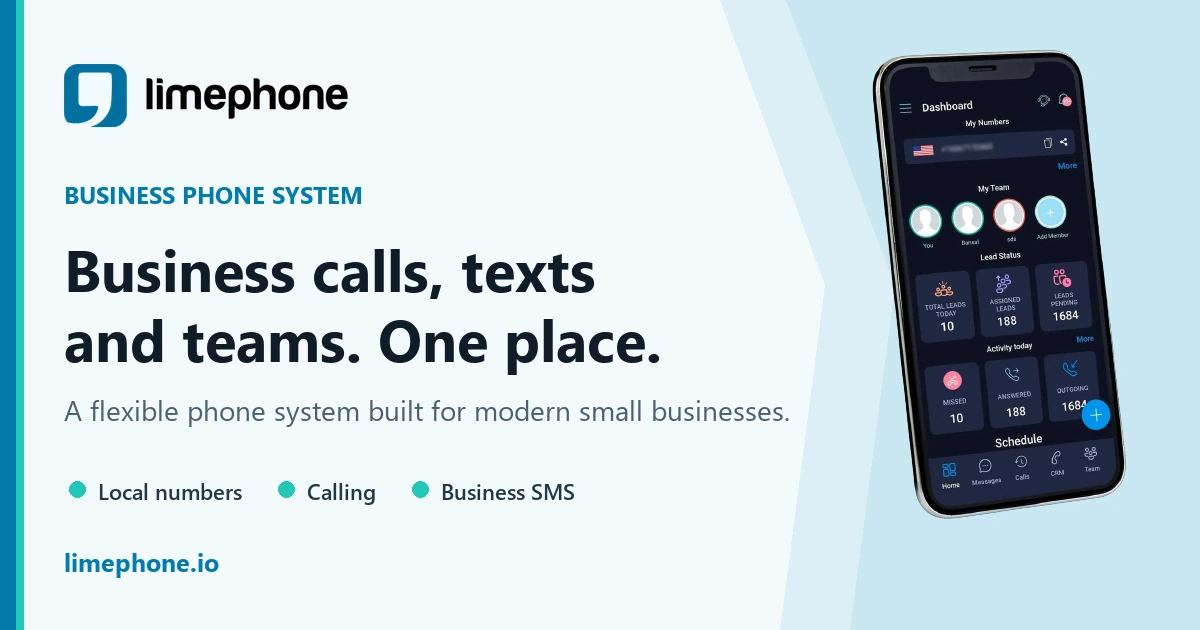
LimePhone is a communication service that provides accessible and efficient solutions to global communication for business owners. The platform offers multiple local virtual numbers, accessible through mobile, desktop, and browser apps. Internal threads, contact notes, and call recordings streamline communication for teams, and LimePhone integrates with popular platforms like Slack, HubSpot, Salesforce, Zapier, and Google Contacts.
Key features:
- HD quality calls: Crystal clear calls via the nation's premium networks.
- Number transfer: Keep your existing numbers and benefit from lower call rates — no communication-system overhaul needed.
- No extra overhead: A fully self-serve platform keeps prices low without added salespeople or support staff.
- Click to Call: Receive calls from web and meeting links, so customers can reach you from anywhere.
- Advanced routing: Set up random or simultaneous dialing sequences so calls get answered quickly.
- Receive calls on the web: Take incoming calls directly in a browser from anywhere.
- Add or remove users: The admin dashboard makes organizing users simple.
- Custom caller ID: Choose the number customers see when you call, keeping branding consistent.
- Voicemail transcription: Get voicemail messages transcribed and delivered by email.
- Scheduled text messages: Schedule one-time and recurring texts to stay on top of customer communication.
Cost:
- The Starter plan costs $9.99 per user per month.
- The Team plan costs $14.99 per user per month.
- Customization options are available for large-scale Enterprise plans.
Plans change as the product grows, so check the current tiers on the LimePhone pricing page.
2. Google Voice

Google Voice is a popular business solution that complements the G Suite of tools — Google's answer to the business phone service market, with many impressive features. Google Voice offers a free personal phone number, but businesses must pay a minimum of $10 per user per month, plus $6 per user per month for the required active Google Workspace account. It also doesn't provide toll-free numbers or a distinction between personal and secondary phone calls.
Key features:
- Free phone number: A free personal number usable for calls, texts, and voicemail on any device — smartphone, tablet, or computer.
- Call forwarding: Forward calls to any number — useful when routing to a specific device.
- Voicemail transcription: Voicemails arrive as readable text.
- Spam filtering: Screens out unwanted calls and texts.
- International calls: Low per-minute international rates.
- Group texting: Message multiple contacts at once.
- Call recording: Record calls for business or personal reference.
- Integration with Google apps: Works with Gmail and Google Calendar.
- Custom greetings: Record personalized voicemail greetings.
- Call screening: Decide whether to answer or send to voicemail based on who's calling.
Cost:
- The Starter plan costs $10 per user per month.
- The Standard plan costs $20 per user per month.
- The Premier plan costs $30 per user per month.
- Google Workspace adds $6 per user per month.
3. Grasshopper

Grasshopper is a long-running VoIP provider with a choice of virtual business phone number plans that can help reduce costs. Its feature set is thinner than the other providers here, though: auto-replies only go out to first-time callers rather than on every call or text, phone numbers cap at 5 on the highest plan without additional fees, integration options are limited, and shared responsibility for incoming calls costs an extra $10 per month — constraints that can pinch as a business grows.
Key features:
- Multiple phone numbers: Choose a local or toll-free number and add extensions for team members or departments.
- Call forwarding: Forward calls to any phone number or device — mobile, desk phone, or laptop.
- Voicemail: Personalized greetings, with messages delivered as email attachments.
- Call screening: Screen incoming calls and choose to answer or send to voicemail.
- Business texting: Send and receive SMS from your business number via the app or web interface.
- Conference calling: Host calls with up to 10 participants.
- Call recording: Recording and playback for quality assurance and training.
- Auto-attendant: An automated IVR menu for incoming callers.
- Mobile app: Manage the phone system from your smartphone.
- Integrations: Connects with Zapier, Slack, and HubSpot.
Cost:
- The Solo plan costs $26 per account per month.
- The Partner plan costs $44 per account per month.
- The Small Business plan costs $80 per account per month.
- Custom quotes are available for personalized plans.
4. Nextiva

Nextiva specializes in video calls and screen sharing. The platform is designed for businesses such as IT and e-commerce, offers 10-digit and toll-free numbers, and reserves integrations with popular platforms like Salesforce and Zendesk for higher-tier plans.
Key features:
- Auto attendant: Custom greetings and menu options that direct callers to the right person or department.
- Unlimited calling: Unlimited calls within the US and Canada with no additional charges.
- Advanced call management: Call forwarding, hold, transfer, and park.
- Mobile app: Calls, texts, and voicemail from your smartphone or tablet.
- Team collaboration: Instant messaging, video conferencing, and screen sharing.
- Voicemail-to-email: Voicemails automatically forwarded to your inbox.
- Integration: Works with Salesforce, Microsoft Teams, and Google Workspace.
- Analytics and reporting: Track call volume, duration, and other metrics.
Cost:
- The Essential plan costs $17.96 per user per month*.
- The Professional plan costs $21.71 per user per month*.
- The Enterprise plan costs $29.21 per user per month*.
- *These prices apply to teams of 1 to 4 users.
5. Ooma

Ooma's VoIP mobile app was developed for small businesses, offering inbound and outbound calling at no charge in North America and Mexico, with extension dialing and call forwarding included for all users. It can prove restrictive as a business scales: there are no analytics to measure activity on the number, the desktop app requires an upgrade, text messaging requires a higher-tier plan, and voicemail transcription and call recording need further upgrades still.
Key features:
- Unlimited calling: Unlimited calls within the US, Canada, and Mexico.
- Virtual receptionist: Customized greetings that direct callers to the right person or department.
- Caller ID: See the name and number of incoming callers.
- 911 calling: Emergency calls to 911 are supported.
- Mobile app: Make and receive calls from your smartphone or tablet.
- Conference calling: Host calls with multiple participants.
- Virtual faxing: Send and receive faxes without a fax machine.
- Number porting: Transfer your existing phone number to Ooma.
- Advanced features: Call recording, ring groups, and integrations with Salesforce, Microsoft Teams, and G Suite on higher tiers.
Cost:
- Ooma Office costs $19.95 per user per month.
- Ooma Office Pro costs $24.95 per user per month.
- Ooma Pro Plus costs $29.95 per user per month.
Which virtual number app is right for your business?
Each of the five apps above has a natural best-fit customer. Match yourself to the profile rather than the feature count:
- LimePhone — budget-conscious teams that want self-serve setup, multiple local numbers, scheduled texting, and broad integrations (Slack, HubSpot, Salesforce, Zapier, Google Contacts) without paying for overhead.
- Google Voice — teams already paying for Google Workspace who want their phone system inside the Google ecosystem and don't need toll-free numbers.
- Grasshopper — micro-businesses that prefer simple per-account pricing over per-user pricing, and can live without call recording on a modern interface.
- Nextiva — teams that lean on video calls and screen sharing as much as phone calls, especially in IT and e-commerce.
- Ooma — small businesses calling mostly within the US, Canada, and Mexico that value 911 support and don't need analytics.
One pricing subtlety worth noticing: Grasshopper charges per account while the others charge per user. For a five-person team, a $14.99-per-user plan and an $80-per-account plan can land in similar territory — always multiply by your actual headcount before comparing.
Should you pick a local or toll-free number for your business?
Most of the apps above offer both, and they behave identically on a call — the difference is perception and who pays:
- Local numbers carry a city's area code, which makes your business feel nearby and familiar. Choose one where your customers are concentrated; it's the stronger trust signal for outbound sales and service calls.
- Toll-free numbers are free for callers to dial and project an established, national image — the traditional choice for support lines serving customers across the country.
Many businesses eventually run both: a local number for outreach, a toll-free number for inbound support. Virtual number apps make that trivial, since adding a number doesn't mean adding a phone line.
How to set up a business virtual number (step by step)
Once you've shortlisted an app, going live typically takes minutes, not days:
- Start a free trial: Most providers offer one — LimePhone's is seven days — so you can test real calls before paying.
- Choose your number: Pick a local area code to build presence in a target city, or a toll-free number for national reach. If you already have a business number, check whether the provider supports transferring it in.
- Verify your account: Providers confirm your identity or business details before activating a number — have basic information ready.
- Configure call handling: Set up call forwarding to your team's devices, record a voicemail greeting, and — if your plan includes it — build an auto-attendant menu so callers reach the right person.
- Register for business texting: If you'll send SMS to US customers, carriers require A2P (application-to-person) registration for business text messaging — sort this early, since messages from unregistered numbers can be blocked.
- Test, then roll out: Place test calls on your own internet connection to check quality, then add team members and share the number with customers.
Common mistakes when choosing a virtual number app
- Comparing headline prices instead of total cost: Add-ons change the math — Grasshopper charges $10/month extra for shared call responsibility and Ooma gates texting, transcription, and recording behind upgrades. Price the plan you'd actually need.
- Ignoring scale limits: A 5-number cap or missing analytics won't hurt on day one, but it will when you add your third hire or second location.
- Assuming emergency calling works: Most virtual number providers don't support 911 or 112 (Ooma is a notable exception) — keep a mobile or landline available for emergencies.
- Skipping the integration check: If calls and texts can't reach your CRM or Slack, your team ends up copy-pasting — verify the specific integrations you need before committing.
- Not using the trial for real calls: Marketing pages can't tell you how a call sounds on your internet connection. Make actual calls during the trial, including from your worst Wi-Fi spot.
- Forgetting about porting: If your current number is on business cards and signage, confirm the new provider supports number transfer before you sign up — moving a published number later is far more painful than checking upfront.
Can you run a business entirely on a virtual number app?
For calls and texts, yes — that's exactly what these apps are built for, and plenty of small businesses have no other phone system at all. Two things to plan around:
- Emergency calling: As covered in the FAQs below, most virtual providers don't support 911/112, so keep a mobile phone available for emergencies.
- Business texting compliance: If you'll text US customers at any volume, complete the carrier A2P registration early — unregistered business SMS can be filtered before it reaches anyone.
Beyond those, the practical ceiling is the plan you're on, not the technology: check that your app's tier includes the analytics, recording, and user counts you'll need a year from now.
Business Virtual Number FAQs
What is a VoIP?
VoIP (Voice over Internet Protocol) is a technology that enables voice communication over the internet, letting users make phone calls and conduct video conferences without traditional phone lines. It converts audio signals into digital data transmitted over the internet — a cost-effective, flexible alternative to traditional phone systems.
Can I only make calls to other virtual phone numbers?
No — you can call any phone number using a virtual phone number, including regular landlines and mobiles. International calls may be limited depending on the vendor and package.
What are the advantages of VoIP phones over traditional landlines?
VoIP phones offer cost savings, flexibility, advanced features, scalability, and integration with other communication and collaboration tools. They can be used from anywhere with an internet connection and support features like call forwarding, voicemail transcription, and video conferencing — capabilities traditional landlines lack.
Can I make 911 calls from a virtual number?
It depends on the provider and the regulations in your country or region, but in general most virtual phone number providers do not support emergency services such as 911 or 112. Confirm before you rely on one as your only line.
Are virtual numbers secure?
Virtual numbers can be secure if proper measures are taken — strong passwords, two-factor authentication, and encryption. Left unprotected, they can be vulnerable to threats like hacking and phishing, so choose a trusted provider and follow cybersecurity best practices.
Can multiple team members share one virtual number?
Yes — that's one of the main reasons businesses choose them. Calls and messages to a shared number can ring several devices simultaneously or route through dialing sequences, and admin dashboards let you add or remove users as the team changes.
How much does a business virtual number app cost?
Based on the plans compared in this article, expect roughly $10 to $30 per user per month for business-grade service, with per-account plans (like Grasshopper's) running $26 to $80 per month regardless of team size. Free options such as Google Voice's personal tier exist, but they lack the business features — shared access, toll-free numbers, integrations — that usually motivate the purchase.
Can I keep my existing business number?
Usually, yes. Number transfer (porting) lets you move an existing number onto a virtual platform — LimePhone supports transferring your existing numbers, and Ooma lets you bring your current number when you switch. Confirm porting support before you commit if your number is printed on business cards and signage.
Do virtual phone numbers need special hardware?
No — that's a core advantage. Virtual numbers require no desk phones, wiring, or on-site infrastructure; the apps run on the smartphones, laptops, and browsers your team already uses. All you need is a reliable internet connection.
How quickly can I get a business virtual number?
Typically the same day, often within minutes: sign up, pick an available number, and complete the provider's verification. The slow paths are porting an existing number in (a process between carriers) and business texting registration — both worth starting early, but neither blocks you from making calls on day one.
LimePhone: A Simple Yet Superior Solution
At LimePhone, we offer a range of transparent price plans, features, and integrative options that provide real value — and we're always expanding what the platform can do. A seven-day free trial lets you test calls and texts for yourself, or you can request a demo to see why so many businesses choose LimePhone as their go-to provider.